
All my life, I’ve loved hiking through the rain forests on Washington State’s Olympic Peninsula. Many trails lead to remote ocean beaches, inaccessible by car. Last summer, my son and I hiked each day, relishing the deep green of the rain forest with long hanging moss draped from trees. Once through the woods, we scrambled onto the sand and smelled the briny tang. We stepped over long thick bull kelp to investigate busy tidepools.
On our last day, we hiked to a new (to us) distant beach. When we got to the shore and looked to the left, in the distance, from shoreline and spreading out to sea, we saw fifteen to twenty giant rock pillars, what the locals called “The Graveyard of the Monsters.” From a distance, they resembled huge beings, once alive.
While we gazed, mesmerized by these fascinating natural sculptures, my son’s nose twitched and he frowned, “I smell death,” he said. His senses being much stronger than mine, I believed him. Around home, that statement usually meant a deceased bird or rodent. I’ve learned to trust him and dutifully followed him to the right, away from the beautiful monsters we had enjoyed, knowing we were on the hunt for a dead creature.
Ahead, about two hundred yards in front of us, piles of rocks formed hundreds of tidepools, each one a wonder of anemones, starfish, hermit crabs and sea urchins. My son’s guest that day, Lea, had never seen tidepools, in fact, she had never been on a Washington ocean beach, with its high piles of huge driftwood logs. We explored the tidepools with joy as the tide rushed in and swirled around our feet.
By this time, I could discern the odor of putrefaction. My son had led us in the right direction; we were getting closer to whatever created the smell. At last, we tore ourselves from the marvels of the tidepools and turned to the far side of the rockpiles.
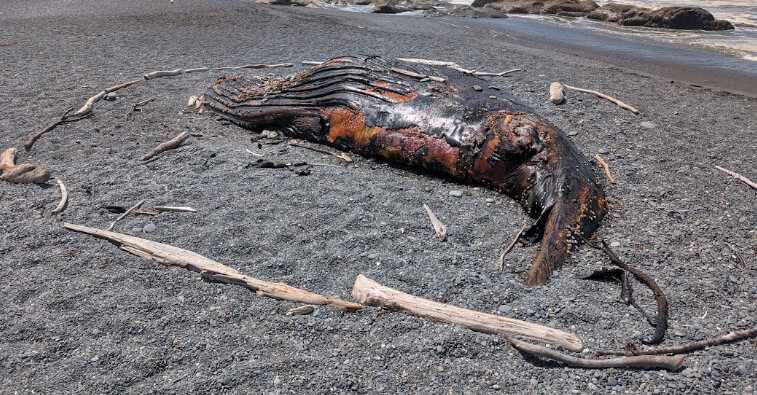
Once beyond the rocks, soon we came upon one of the saddest sights I’d ever seen: a beached humpback whale. It seemed to be smaller than an adult, more than twenty feet long. We marched closer and were amazed at how well preserved it was; no scavengers had partaken of it. We looked up and saw eagles above. I knew the woods had coyotes, bear, racoon and cougar aplenty. Why had none of them eaten it? This remained a mystery to us. At a rough guess, the carcass seemed to be about three weeks old or more.
When we got closer, we saw that other people had surrounded the whale with a respectful oval of driftwood pieces, each five or six feet long. To me, it felt like a sacred space had been created. I noticed eight rounded stones, each about the size of the palm of a hand, gently placed on different parts of the whale’s body. This reminded me of the rocks set on top of Jewish graves as a sign of respect and prayer.
We stood silently before this humungous amazement. I mentally said Buddhist prayers for the cetacean. In the past, at cemeteries, I offered to say Buddhist prayers out loud to my agnostic family if they wanted me to. They usually did. But this time, the surprise of seeing the poor beast was overwhelming, leaving me almost speechless. On the trails in the past week, we had been surprised to hear a variety of languages from Scandinavian to Asian. It occurred to me that this whale had probably attracted a lot of prayers from people all over the world.
I walked in a circle around the whale to send my devotional wishes from all sides. When I got back to my son and Lea, we chatted in low voices. They seemed to be as much in awe as I. As we walked away, Lea asked, “Do you always see beached whales at the ocean in Washington?” My son and I couldn’t help smiling while we told her how rare it was.
Although being close to a giant of the deep on a beach was one of the most awe-inspiring events of my life, I hoped never to see another because I felt deep sorrow for the loss of such a magnificent life. “This is my first time, and, I hope, my last,” I said to her.

Real Life – Real Laughs:
Humor When You Need It Most
Cate Burns’ thirty-eight non-fiction stories of heartfelt humor explore society’s foibles and personal snafus with insightful zingers that will delight readers. Burns casts an unstinting, cock-eyed look at personal change, friendship, sanity and courage.
“Absolutely LOVE the descriptions in this work. Very, very, very clever and, dare I say it? -unique. This is refreshing, funny, inventive and delightful.” -Sharon Whitehill, Ph. D.
